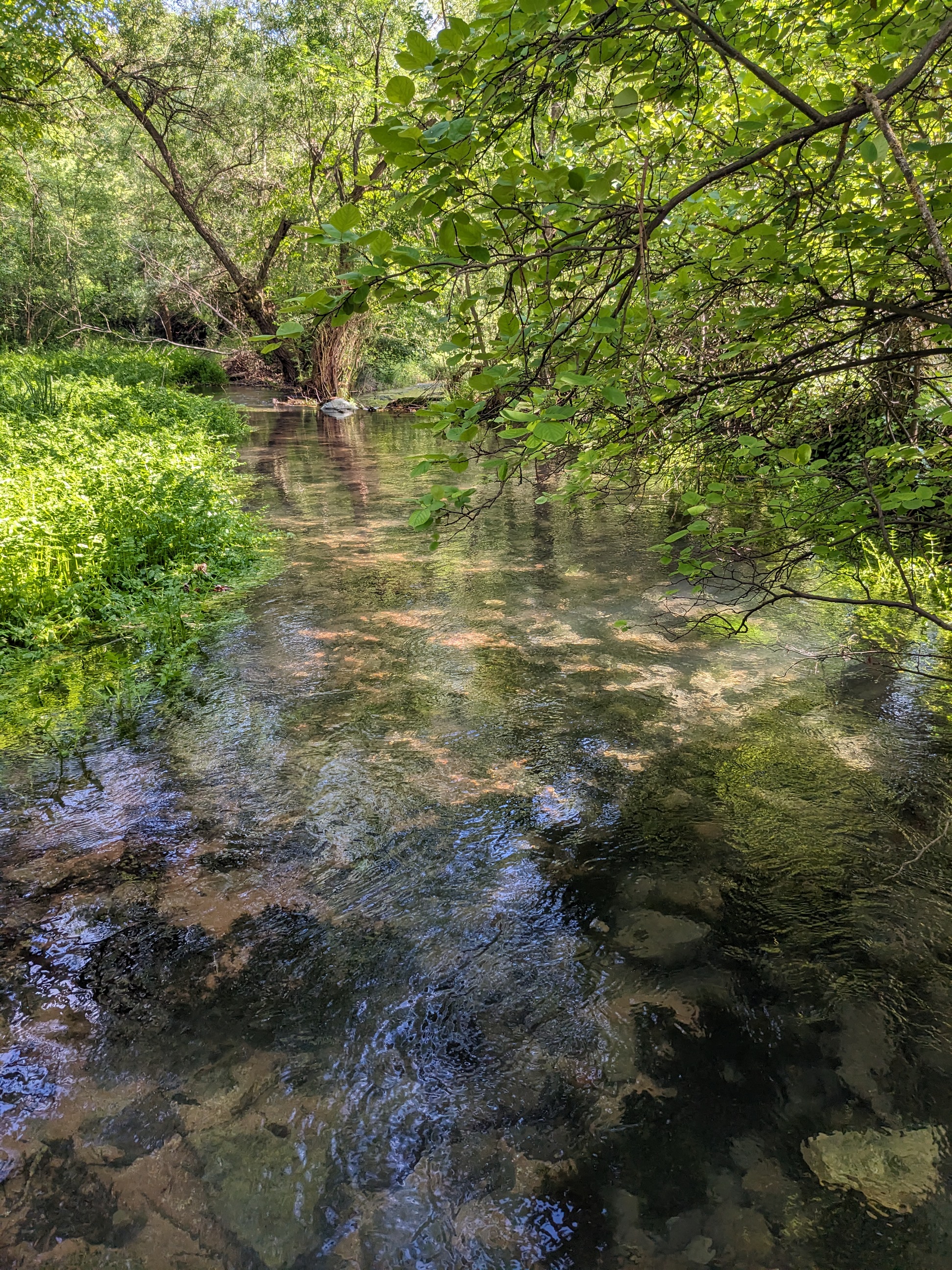
A forgotten curve of Crnica. The river changed its course several years ago, and this stretch exists now only in photographs and memories.
Q: How did you first discover Neil Patterson and his book Chalkstream Chronicle? What was your life as an angler and writer at that time?
I discovered the book shortly after it became available in the United States. I believe I first saw it at the Borders Cafe bookstore. I was absolutely stunned by it.
It was extremely personal and observant, and I felt like I had seen parts of it already, almost as if from a previous life. Of course, Balkan streams are not identical to English chalkstreams, but there are striking similarities: the limestone, the clear water, and the relationship between the landscape and the river.
And then there was the artistic element—a thread connecting everything together. The book was not only about fishing. It was about seeing.
Q: What was it about Neil’s writing that stayed with you? Was it the fishing knowledge, the descriptions of the river, the way he connected nature and human experience, or something else?
It was a combination of many things.
The drawings were unique. The hatch chart at the end of the book was beautiful. The fly patterns he shared were honest, practical, and elegant. They were not created to impress; they were created because they worked and because they belonged to that particular river.
Neil also had a love for soft feathers and traditional materials. Balkan fly anglers have that same connection. When you compare older English fly patterns with traditional patterns from Bosnia, Montenegro, and other parts of the Balkans, there are fascinating similarities.
The Balkan Peninsula is also full of limestone trout streams. Different landscapes and different histories, but a shared relationship between geology, insects, and trout.
Q: Looking back, do you think Neil influenced the way you started writing your own blog—especially the idea of writing not only about fish, but also about places, seasons, memories, and life around the water?
Absolutely. Neil has probably been the greatest influence on my writing about fishing and rivers.
I have had other important influences as well: Ernie Schwiebert, Ernest Hemingway, Arnold Gingrich, Nick Lyons, Roderick Haig-Brown, among others. We are fortunate that these wonderful people left so much behind for future generations of anglers.
Neil’s writing about one specific river was especially meaningful to me. I recognized that idea immediately. I also have my own river—a small stream connected to my family story and my own memories.
I also have to connect this idea to music. I remember Pat Metheny saying in an interview that, in a sense, all of us write only one song. Of course, not literally, but perhaps every artist spends a lifetime creating variations of the same deeper story.
Kenny Wheeler expressed something similar in his beautiful composition Everybody’s Song But My Own. We all have one story, with millions of variations.
Q: You have fished many different waters: Serbian limestone streams, New England saltwater, and Driftless streams in Iowa, Minnesota, and Wisconsin. What connection do you see between Neil’s River Kennet and the rivers that have shaped your own life?
Those rivers represent some of the most unique environments where trout can live.
They are wild yet gentle, mysterious yet approachable, complex and sometimes incredibly easy. In many ways, they are like human life.
They can be silent for a long time, then suddenly become full of energy and surprises. They test your patience, but they reward you as well.
There is a special biological power in calcium carbonate landscapes—whether it is an English chalkstream, a Driftless limestone creek, or a Balkan karst stream.
Q: Why did you feel that this particular interview with Neil was worth sharing now? What did seeing him on the Kennet bring back for you?
It brought back calmness, poetry in fishing, and honesty.
There was no loud action music, no attempt to make fishing look like a competition or an extreme sport. Some modern fly fishing videos present fishing almost like a Formula 1 race. That has its place, but it is not what I personally look for.
Neil represents something different: observation, patience, connection, and love for a particular place.
Q: After all these years of fishing and writing, what do you think makes a river become more than just a place where fish live?
First and foremost, it is your love for it.
Rivers are like people. Their beauty is sometimes hidden beneath many layers. The more time you spend with them, the more those layers are revealed.
There is also always some kind of personal connection. Sometimes a river is simply given to you. My small stream was “given” to me because it was connected to my family history.
Other rivers you discover and slowly fall deeply in love with. The way the landscape and geology fit together, the history attached to a place—these things create something much deeper.
Think of rivers like the Test, Itchen, Silver Creek, or the Henry’s Fork. They carry remarkable histories.
But it can also be a much smaller and lesser-known river. Sometimes those unknown streams hide deeper mysteries than anyone could possibly imagine. Even after decades, I still uncover and learn new things, year after year.
Neil Patterson — River Kennet interview excerpt: