Showing posts with label Sisevac Caddis. Show all posts

Sunday, August 09, 2026

Searching for Silver Sedge

(Photo: Odontocerum albicorne, Trawscoed, North Wales, August 2015. Photo by Janet Graham, via Wikimedia Commons. Licensed under CC BY 2.0.)

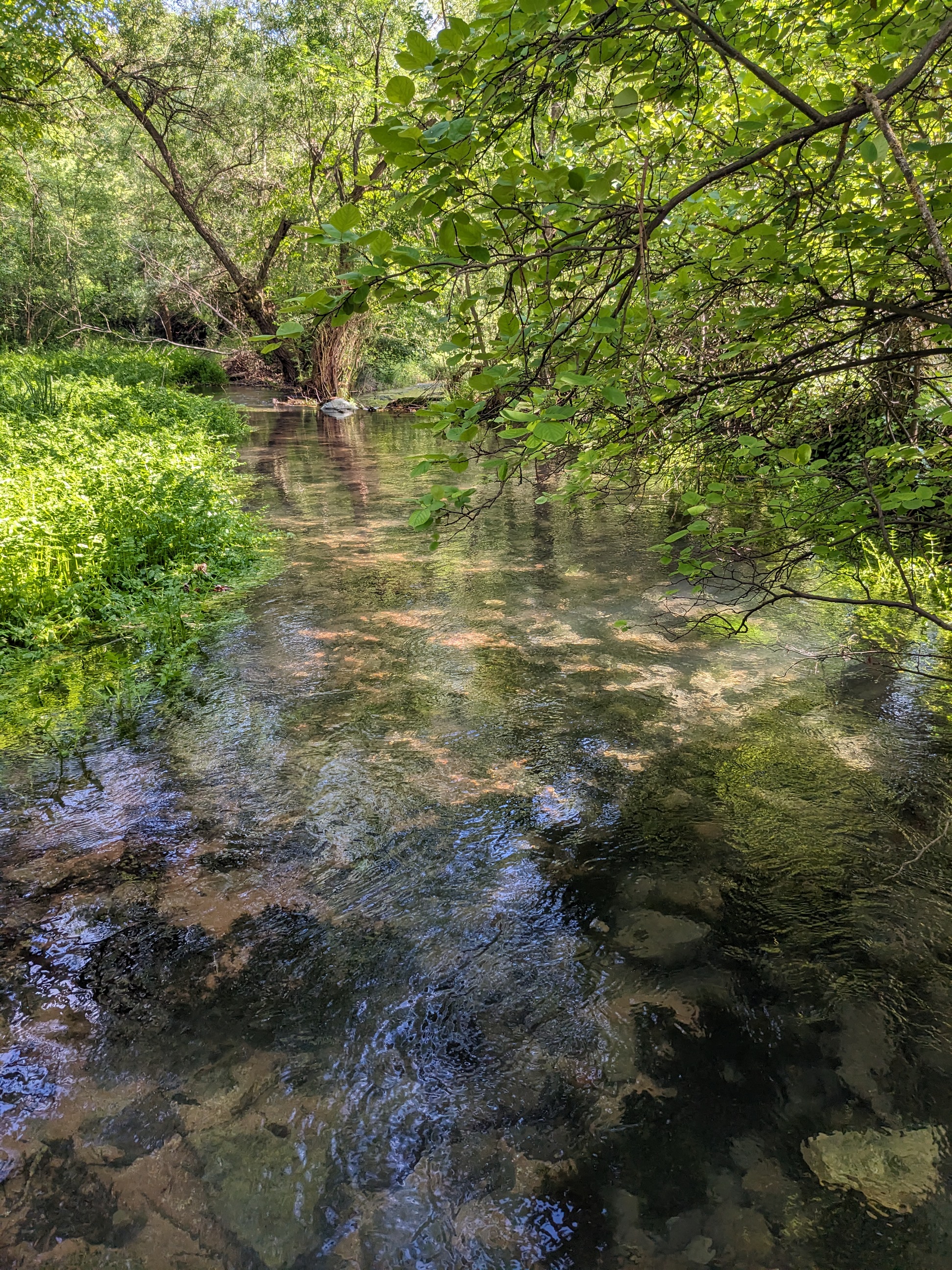
Two days ago I spent almost four hours on the phone with my friend Dave Skok. We talked about trout and striped bass fishing, sight casting, dry flies, spring creeks, hatches, and fly rods. That conversation somehow sent me looking for a particular insect I thought I might have seen on my trout water, the Moesian karst stream Crnica in eastern Serbia.

I have spent countless hours reading its currents, turning over its river stones, and trying to fool its trout. Yet even after all these years, the river still manages to keep secrets from me. It concerns a magnificent, heavily structured caddisfly that I suspect may be hiding right under our noses: Odontocerum albicorne, famously known to fly anglers as the Silver Sedge.

If you look at European entomology maps, the Silver Sedge is a documented resident of the region. It has been recently documented in Montenegro and is present in Bulgaria. It is also included in published lists of the Trichoptera fauna of Serbia. However, I have a confession to make: I don't believe I have ever personally seen one on the Crnica.

But before you call me crazy for speculating on its existence, consider the timeline. Odontocerum albicorne is a summer specialist. Its peak emergence occurs from June through July and stretches into August. For many years, my calendar has kept me away from the river during those exact sweltering summer months.

Could this beautiful insect be hatching in the warm summer twilights while I am wading the flats around Boston, looking for striped bass, far away from the Crnica? I think it is entirely possible.

I have, over the years, observed an enormous biodiversity of aquatic insects on the Crnica. I have also found that another almost identical species is documented in the Balkans, Odontocerum hellenicum. Based on the current data, it seems that O. hellenicum would be more likely to occur farther south, in the Stara Planina region.

To understand why the Crnica is a prime candidate for the Silver Sedge, you have to look at how these insects live. The larvae are master underwater stonemasons, constructing incredibly strong, curved defensive cases entirely out of tightly bound grains of sand. They don't just live anywhere—they require clean, permanent, moderate-to-fast flowing water with a rich substrate of gravel and boulders.

The pristine, well-oxygenated upper stretches of the Crnica fit this ecological profile perfectly.

When they do emerge, they are not small caddisflies. The adults boast a substantial forewing length of 13–18 mm, easily identified by their distinctively long, aggressively toothed antennae and striking silver-grey appearance when resting on riparian foliage. For a trout, an adult Silver Sedge or its swimming pupa represents a high-calorie steak dinner.

I am hoping that next June I will dedicate some time to setting UV light traps and doing more sampling of insects along the banks of the Crnica. I hope this ghost story will eventually be solved!

A Few Things I Found Down the Rabbit Hole

While I was a biology student in Belgrade in the late 1980s, one of my dearest professors was Miloje Brajković. I told him way back then about my interest in fly fishing and angling entomology. He smiled and gave me some tips and encouragement as I began collecting specimens, along with resources for identification.

So I am listing his work on top…

Živić, I., Marković, Z. & Brajković, M. (2006). Contribution to the faunistical list of Trichoptera (Insecta) of Serbia.Acta Entomologica Slovenica 14(1): 55–68.
— A very useful general Serbian caddisfly reference; the revised list increased the known Serbian Trichoptera fauna from 173 to 186 species.

Novaković, B., Stojanović, K., Marković, V., Radojević, A., Božanić, M. & Živić, I. (2017). A Valorization of Benthic Invertebrate Fauna of the Mlava River (Eastern Serbia).
— The Mlava survey: 197 benthic taxa recorded during 2009–2014.

Stojanović et al. (2018). Odontocerum hellenicum (Malicky, 1972) (Trichoptera: Odontoceridae) as a host of Agriotypus armatus (Curtis, 1832) (Hymenoptera: Ichneumonidae) — the first finding for Serbia.
— Particularly relevant to the southeastern-Serbia angle.

Klima, F. & Hodges, J. C. (1987). Description of the Larva and Female of Odontocerum hellenicum Malicky, 1972, as Compared to O. albicorne Scopoli, 1763 (Trichoptera: Odontoceridae). Aquatic Insects 9(3): 177–183.
— The really useful hellenicum/albicorne comparison.

Kiss, O. & Pfliegler, W. P. (2011). The biology and life cycle of Odontocerum albicorne (Scopoli, 1763) (Trichoptera).
— Excellent general natural-history source; also discusses the Balkan Odontocerum species and the Bulgarian O. hellenicum records.

Kumanski, K. (1981). Faunistic investigations on Bulgarian Trichoptera to June, 1980 — with a revised check-list. In: Moretti, G. P. (ed.), Proceedings of the 3rd International Symposium on Trichoptera, Series Entomologica 20: 139–147.
— The older Bulgarian source behind the O. hellenicum connection.

Malicky, H. (1972). Weitere neue Arten und Fundorte von Westpaläarktischen Köcherfliegen (Trichoptera), von allem aus dem östlichen Mediterrangebiet. Mitteilungen der Entomologischen Gesellschaft Basel 22: 25–68.
— The original description of Odontocerum hellenicum.

Bozdoğan, H., Bilalli, A. & Ibrahimi, H. (2025). New caddisfly records (Insecta, Trichoptera) for Montenegro and Ecoregion 5, Dinaric Western Balkans: distributional and ecological insights. Biodiversity Data Journal 13: e146076.
O. albicorne was documented on the Zeta River in Montenegro using a UV light trap on July 22, 2024; five males and nine females were recorded.

Tuesday, June 23, 2026

The Giants of Autumn: Understanding Large Limnephilids on Eastern Serbian Karst Stream

For anglers exploring the cold limestone headwaters of the Balkans, few aquatic insects play a larger role in the late-season ecology of karst streams than the large caddisflies of the family Limnephilidae. Robust, highly visible, and often active when many other insects have disappeared, these species help define the final chapters of the trout season. By combining biological observations with years spent fishing these waters, we can better understand the distinct roles these aquatic giants play in both the stream ecosystem and the fly box.


1. The Genus Potamophylax: From Spring Beginnings to Autumn Glory


While many anglers associate large limnephilid caddisflies exclusively with autumn, the life cycle of the genus Potamophylax spans much of the fishing season.


The Spring Window

In late spring, species such as Potamophylax pallidus begin to emerge along cold mountain streams. Solitary adults can often be found resting on streamside rocks during cool evenings. Their pale amber wings, illuminated by a flashlight or camera flash, create a surprisingly striking appearance against the darkness. For trout recovering from winter, these early-season insects provide an important source of nutrition.


The Autumn Shift

As summer fades into September, the larger Potamophylax cingulatus becomes increasingly important. While its close relative P. latipennis is more commonly associated with broader, slower-flowing river systems, densely forested karst headwaters remain the stronghold of P. cingulatus.


The larvae construct heavy stone cases that allow them to withstand the powerful currents characteristic of limestone streams. The appearance of the adults often coincides with some of the most aggressive surface feeding of the season by resident brown trout.


2. The Genus Stenophylax: The Mystery of Summer Diapause


One of the most fascinating biological adaptations among Balkan limnephilids is the summer diapause exhibited by Stenophylax permistus.


Adults emerge during late spring but postpone reproduction until conditions become favorable. Rather than remaining active during the hottest months, they seek refuge in shaded forests, caves, and limestone crevices surrounding karst springs and headwaters.


Although they are rarely observed hatching in large numbers during midsummer, these insects remain an important food source. Wind, rain, or simple accidents occasionally send adults tumbling from overhanging vegetation onto the water's surface. Such large, protein-rich insects represent a substantial meal that larger trout seldom ignore.


3. The Genus Halesus: Closing the Season with Halesus digitatus


As October arrives and mountain mornings grow colder, the emergence of the true autumn giants begins. This is the time of Caperer! While Halesus radiatus is widespread throughout many southern and southeastern river systems of Serbia, Halesus digitatus stands out as the definitive jesenji gorostas—the autumn giant—of the eastern limestone mountains.


With wingspans exceeding 40 mm and distinctive mottled wing patterns, these impressive insects often appear during cool, overcast afternoons. Their emergence marks one of the final major insect events before winter and the onset of trout spawning closures.


For fly tiers, few hatches are more rewarding to imitate. Large deer-hair adults tied on hooks #6–#8 and robust olive-cream pupal patterns closely match the natural insects and provide a fitting way to conclude the trout season.


How to Fish the Large Limnephilids


Large limnephilid caddisflies differ from the smaller species that dominate summer trout fishing. Their size, clumsy flight, and seasonal timing create unique opportunities for observant anglers.


When fishing adult patterns, concentrate on low-light periods, overcast afternoons, and the final hours before dusk. Many species are relatively poor fliers and frequently end up trapped in the surface film. Trout often feed more confidently on these large insects than on smaller mayflies or midges.


Do not overlook the pupal stage. In many cases, trout begin feeding on ascending pupae before any obvious adult activity becomes visible. A lightly weighted caddis pupa swung across current seams can be remarkably effective during periods of emergence.


Adult imitations should generally be presented dead-drift first. If trout refuse the fly, occasional twitches or gentle skating can imitate the struggles of a natural insect attempting to escape the water.


Most importantly, remember that these insects represent a substantial meal. Trout feeding on large limnephilids often abandon their usual caution. The rises may be fewer in number than during a mayfly hatch, but they are frequently more deliberate and more memorable.


For anglers fortunate enough to fish the limestone headwaters of the Balkans, the appearance of these great autumn caddisflies signals the approaching end of another season—and some of the finest dry-fly fishing of the year.


A selection of author's patterns inspired by observations of Potamophylax, Stenophylax, and other large limnephilid caddisflies found on eastern Serbian limestone streams.

Monday, June 22, 2026

From Berula to Trout: A Karst Stream Connection

Along the margins and shallow runs of my favorite spring-fed karst river grows the aquatic plant Berula erectaIts submerged stems and finely divided leaves form low underwater thickets that slow the current and create structure in otherwise uniform flow.

Within these beds lives a dense invertebrate community. Most visible are blackfly larvae (Simulium spp.), attached to stems where they filter fine organic matter from the current. Alongside them are grazing mayfly nymphs, caddis larvae, amphipods (Gammarus), and other aquatic insects, all using the vegetation for food, refuge, or both.

For trout, these Berula beds function as feeding stations rather than simple cover. The plant concentrates the insects and crustaceans that drive much of the river’s productivity through the seasons. Where Berula is present and well developed, aquatic life is often noticeably concentrated.

The idea for the Sisevac Caddis arose directly from observing this microhabitat. Although the pattern is tied to local caddisflies in design, it really represents something broader—the biological richness generated by spring-fed, vegetated water.

Seen this way, the river is not defined only by its fish, but by what supports them: plants shaping current, insects inhabiting that structure, and trout moving through it in response.


Tuesday, June 16, 2026

The Sisevac Caddis

Back in the winter of 2011, I obtained some natural emu feathers. Initially, I had in mind tying a few sandworm gurgler-inspired patterns with them. The feathers were beautiful and made wonderfully enticing tails on sandworm imitations. I fished those successfully for stripers on various beaches along Boston’s North Shore.

Then, in January of 2012, while sitting at the vise dreaming of summer trout fishing, an idea suddenly appeared: why not attempt a dry fly with these feathers?

Some of the emu barbules were slightly stiffer, while others were extremely soft. At the same time, I had long been fond of clipped-hackle flies. The Klinkhåmer was one of my favorite prospecting flies back then, both on Driftless streams and on the small karst rivers of eastern Serbia.

I also always loved soft-hackled flies and was deeply inspired by old Balkan fly patterns that used local wild bird feathers such as owl, jay, duck and crow. Emu reminded me somewhat of owl feather in texture and movement, although structurally the feather is, of course, quite different.

So I combined these ideas and came up with this impressionistic caddis imitation. The pattern is essentially what happens when a saltwater material, Balkan soft-feather sensibility, and limestone-stream trout fishing converge into one fly.

I decided to call it the Sisevac Caddis, after the small Serbian village of Sisevac, my fishing home base on the Crnica River.

Sisevac itself carries layers of memory that go beyond fishing. Long before the mining period, the area was already shaped by the presence of the 14th-century St. Sisoje of Sinai monastery, from which the village of Sisevac takes its name, embedded in the older cultural landscape of the Crnica valley. The river was later described in the 19th century by Hungarian naturalist Félix Philipp Kanitz, who recorded the region’s karst formations and the clarity of its waters in his travel and scientific observations. In the early 20th century, it was still shaped by its mining-era character, and daily life moving closely with the rhythm of extraction and water. A family photograph from the 1930s — taken during a wedding in Sisevac — preserves a moment of stillness within that motion: figures gathered in formal dress, light falling across a landscape that is neither rural nor industrial, but suspended between states. It belongs to a time when the river and its valley were not yet “observed,” but simply lived within, as part of an ongoing flow of hard work, travel, and gathering.


Recipe

Hook: Size 12–14 curved wide-gape hook (such as Daiichi 1130)

Body: Palmered natural emu hackle, clipped on the inner side of the curve

Thorax: Golden brown or Peacock Ice Dub, or similar material

Parapost: Polypropylene

Parachute hackle: Ginger, brown, or sandy dun rooster hackle, depending on local caddis coloration


I first tested the fly in Iowa’s Driftless region and it worked beautifully. Later, I brought it to Serbia, where it performed wonderfully on my old home streams. My old friend Dave Skok liked the pattern as well, and we fished it successfully near his home waters on the Deerfield River in western Massachusetts.

The Sisevac Caddis is something of a semi-damp dry fly. It can imitate a crippled or emerging caddis, but it may also pass for a spent insect—or simply whatever the trout wants it to be at that particular moment. I believe much of the fly’s effectiveness comes from the way light refracts through the emu barbules. The fibers move almost like CDC, although they do benefit from a good treatment with quality desiccant powder before fishing. A powder such as Tiemco Shimazaki Fly Shake gives the fly what I like to call a subtle “moth factor.”

It is an excellent flatwater fly, best fished dead drift or with tiny twitches. At the same time, it floats well enough for moderate riffled water and lands on the surface like a whisper—something I have always loved about this pattern.

Image references

Figure 1: Sisevac wedding photograph (1930s), family archive.
A historical image from the mining-era settlement period in Sisevac, capturing community life in the Crnica valley.
Figure 2: Crnica River spring system, Sisevac.
The emergence of the river from its underground course through limestone and rock formations.
Figure 3: Small wild brown trout, Crnica River.
Native trout from the system that the Sisevac Caddis is intended to suggest.
Figure 4: The Sisevac Caddis fly pattern.
A clipped-hackle, emu-based caddis imitation developed from mixed saltwater and Balkan soft-feather influences.

Wednesday, June 05, 2024

Back in Serbia

Fly fishing karst streams, hiking Rtanj, collecting insect samples. Potamophylax pallidus can be seen on the very last photo. This large cinnamon sedge was photographed on May 26.


Sunday, March 17, 2019

Sisevac Caddis Revisited

Always fun to tie...and works in mysterious ways. I believe the success of this fly is tied to the light refraction through the emu feather barbules. They move almost like CDC, but do need a good bath in a quality desiccant powder prior to use (like Tiemco Shimazaki Fly Shake). The powder will make the fly ooze the "moth factor." It is a flat water fly, best fished dead drift, or with tiny twitches.


Saturday, May 23, 2015

Sisevac Caddis

Tying few more flies before my trip...Here's an old favorite revisited.